11/8/2011
Interviewer: Hanquan Cai (Jack)
Interviewee: Ayoa Abebe
Process Description
Since my first interviewee is from Ethiopia, so I was looking for another Ethiopian as my second interviewee. I talked to one of my friend, she said she could introduce me someone who is from that country. So we scheduled to meet each other on Monday afternoon at the information desk in Atwood. I printed out two question sheets and thought about my first interview, tried to think about what places I should change and improve. I checked my ipod which was used for recording since it worked very well for the first time. Finally, I went to Atwood after everything was set. I waited for her for around 5 minutes, and we walked around try to find a quiet place after we met. We went to second floor and found a table in a corner where not many people passed. I handed the sheet to her and gave here about 5 minutes to quick scan all the questions and tell me if there is something confusing. Finally we got started; it took us about 15 minutes in total and it went very well, I thanked her for being there, and then I left.


Personal Review
I think I learned a lot from the first interview, which gave me a lot of helps, especially about how to make the interview smoother and more interesting. I spent a lot of time preparing for the second interview; I looked at all the questions that I used for the first time, because I thought there is something that I can improve, for example, I found that there was some disconnections in my first interview when I asked the questions, because I did not prepare any sub questions that I could use in order to go deeper. I wrote at least one sub questions under each question this time. And I asked my interviewee to look at all the questions first for 5 minutes this time, and also asked her to tell me if there was something that she does not know or not, because I did not want to have an awkward moment in between. So I think everything was going very well this time, and I had some fun when we talked some questions because of the difference of the culture between her country and my country, which actually made the interview more interesting and made me feel a lot more comfortable. Anyway, it went very well, and I think I know a lot about Ethiopia now after these two interviews.
Country Report
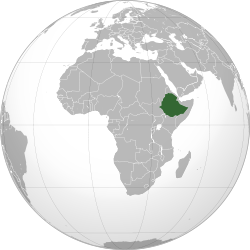
My interviewee is from Ethiopia, which I never really get to know before; here is some information about it.
Ethiopia is located in the northeast of Africa. It is the second-most populous nation in Africa, with over 82 million people and its capital is Addis Ababa. Ethiopia is surrounded by Eritrea, Sudan , South Sudan, Djibouti , Somalia , and Kenya. Ethiopian is known as one of the oldest site of human existence in the world, its history can be traced back to thousands of years ago. “The politics of Ethiopia takes place in a framework of a federal parliamentary republic, whereby the Prime Minister is the head of government. Executive power is exercised by the government. Federal legislative power is vested in both the government and the two chambers of parliament” (1).
The Ethiopian economy is based on agriculture, “which contributes 42% to GDP and more than 80% of exports, and employs 80% of the population. The major agricultural export crop is coffee, providing approximately 26% of Ethiopia's foreign exchange earnings, down from 65% a decade ago because of the slump in coffee prices since the mid-1990s and increases in other exports”(2).

Ethiopia has almost 50 different domestic languages, but a lot of people know how to speak English that is the most popular foreign language in its country. Moreover, there are also numerous indigenous African religions in Ethiopia, mainly located in the far southwest and western country, and the most popular religions are Christianity and Muslim.
1. http://en.wikipedia.org/wiki/Politics_of_Ethiopia
2. http://www.state.gov/r/pa/ei/bgn/2859.htm#econ
Transcript of the interview
J: Hanquan Cai (Jack)
A: Ayoa Abebe
J: I am Jack and I am from China, it is so good to see you today and thank you for helping me with the interview. So what is your name?
A: It is good to see you too, my name is Ayoa Abebe.
J: Where are you from?
A: I am from Ethiopia, it is In Africa.
J: Ok, can you describe the education system of your country?
A: Ok, the education system is the English system in Ethiopia, like here, except in public school that it is harder for students than here, because we do not have enough books and materials for our students, so it is a little bit harder.
J: You have all the classes, but just do not have enough books?
A: yes, because people cannot afford it.
J: That is interesting. Ok, how has your culture influenced your people/family values?
A: I think culture has a big influence on my family, like my dad, he is very close to his culture; everything he does is not against our culture. For me, even though I am in America, I still celebrate everything holiday we have in Ethiopia with the outfits on sometimes. For the family value, I think everywhere is the same; we have to respect our parents and the elders. And we go to church on every Sunday, we stand up when people come, and we seat when they seat.
J: Nice, so what is the form of government in your country?
A: The government’s form is a little bit different now, because the premier is the president. And he has been on the position for like 20 years now. It has not changed, because he does not want to leave. He likes it.
J: What? I think this is not up to him. How old is he now?
A: He is like 50, or something.
J: That is not too bad. 20 years, that is very long. In my country, we select every four years, you can renounce reappointment once, so you can be in the office for 8 years at most.
A: In my country, we do it every 5 years, but he is in power, so…..
J: Ok, I see, tell me one thing that makes you proud of your country.
A: Huh, the most impressive thing I think is that Ethiopia has never been colonized before; there are only two countries in Africa that have never been colonized in the past. So I am proud to talk about that. Other than that I really like the dancing and the food.
J: Cool. So what places/sites would you recommend to the tourists?
A: I would recommend Lalibela, it is a church made of big rocks, it is very beautiful, I also recommend Oxum, it is historical places and other lakes I think they should visit as well.
J: Sweet, so what festivals do you celebrate in your country?
A: We celebrate Christmas a lot, Easter, New Years and also Epiphany.
J: Happy Fanny? What is it?
A: Hehe, it is epiphany, not happy fanny. It is about memorizing Jesus Crises, what is your religion?
J: I am an atheist.
A: Ok, I see.
J: So what is the weather like in your hometown?
A: The weather is nothing to compare with that in MN, it is very hot there, always warm, it is 60-70 degrees every day. It rains a little, no snow.
J: How do you like it compare with here?
A: I like it better there.
J: there? I like here better, because I prefer living in a cold place to a hot and humid place, like my hometown. So what is a type of sport in your country?
A: The most famous would be racing.
J: Seriously, not soccer?
A: Soccer, yea, the two. Hehe
J: so racing, soccer and basketball?
A: not basketball, not many people plays it.
J: Ok, what is a traditional food in your country?
A: The traditional food would be chicken sauce with injera that is a type of bread. So you just dip the bread in the sauce with your hand and eat it.
J: Sounds delicious, what kind of sauce is it?
A: it is spicy sauce, we like spicy food.
J: I like spicy food too, ok, so how old are people in your country by the time the get married?
A: Now maybe 25 years old.
J: why do you say now? What was it like before?
A: Before was like 13, my grand mom got married when she was 15, and her sister got married when she was 13.
J: 13, that is a little girl. People in my country will get married on the age of 21 or something, not 13. So what do most women do after they get married in your country?
A: long time ago, maybe like 30 years ago, they just stay at home as housewives. But now they go to school or they work.
J: what about the children, who takes care of them?
A: we have maids; most of people will hire a maid work at home, cook and take care of the children. She basically lives with us.
J: That is nice, how many children does each family usually have in your country?
A: Basically, each family has about 4 kids, your country allows you to only have one, right?
J: I am the only child in my family.
A: Why?
J: because of the overpopulation problem. We have too many people right now. So are children in your country responsible for taking care of their parents in their old age?
A: Yes, you have to, it is part of the culture, when you are grown, you either bring them to your house they live with you or you go to their house every weekend, you help them with everything, if they are sick, your bring them food. You do everything, if they need to shower, you have to shower them, and you also pay their rent sometimes.
J: This is not like in America.
A: No, especially I am in America now, but if my mom needs money in Ethiopia, I have to send money to her, it is expected that I send money to her and help her.
J: Ok, the last question, what is people’s religion in your country?
A: 40% Muslims and 60% Christians, I am a Christian.
J: I see, do you still go to church here?
A: Not here, but I go to church in Minneapolis, because my aunt lives there, I go there very often on the weekends.
J: Nice, it is good to have some family members here. Anyway, thank you so much for helping me.
A: You are welcome.
J: bye.
A: bye.